
The 5 Best Vinyl Windows of 2026, Ranked by Published U-Factor
The spread between the best and the worst vinyl window on this list is 0.09 on the U-factor scale, which sounds like a rounding error and is actually the difference between a window certified in every ENERGY STAR climate zone and one certified in none. We ranked five widely sold vinyl lines on one thing: the lowest whole-window U-factor each manufacturer or its retailer actually publishes, with the exact configuration named. Two of the five publish nothing at all, which is why they are not here.
Key Takeaways
- Simonton Reflections 5500 publishes the lowest figure here, 0.20, on a triple-pane double-hung with ProSolar Low-E glass and krypton fill (Simonton sell sheet).
- ENERGY STAR Version 7.0 asks for 0.22 or lower in the Northern zone and 0.32 or lower in the Southern zone, with a new minimum solar heat gain of 0.17 in the north (ENERGY STAR 7.0 summary).
- The series name tells you almost nothing. Three JELD-WEN V-2500 listings at three sizes publish 0.25, 0.26 and 0.33, and only some are certified.
- The federal window tax credit is gone. Section 25C does not apply to windows placed in service after December 31, 2025 (Pease Bell summary).
- Budget $350 to $800 per window installed, averaging $575 in the January 2026 national figures (Fixr).
Cost Ranges
| Source | Range per window installed | Average | What it is measuring |
|---|---|---|---|
| Fixr, January 2026 | $350 to $800 | $575 | National average, vinyl, installed |
| Inch Calculator, 2026 | $400 to $800 | Not stated | National average, vinyl, installed |
| Pella, 2026 | $800 to $1,600 | Not stated | Manufacturer's own dealer-installed projects |
Planning ranges from Fixr, Inch Calculator and Pella. Not quotes. Size, glass package, local labor rates and any carpentry in the opening move all of them.
Project Timeline
Material Comparison
| Line | Lowest published U-factor | Configuration | ENERGY STAR as listed | Warranty | Where sold |
|---|---|---|---|---|---|
| Simonton Reflections 5500 | 0.20 | Triple-pane double-hung, ProSolar Low-E, krypton | Most Efficient, select styles, 2023 | Double Lifetime Limited, 3-year glass breakage | Dealer |
| Pella 250 Series | 0.20 | Triple-pane casement; 0.26 dual-pane fixed frame | Most Efficient recognition, 2024 | Limited lifetime | Lowe's |
| JELD-WEN V-2500 | 0.26 | Dual-pane slider, 47.5 by 47.5 in | Certified, Northern zone, on that unit | Lifetime limited, glass breakage included | Lowe's, Home Depot |
| ReliaBilt 3900 | 0.29 | Dual-pane double-hung replacement | Certified in 3 zones, not Northern | Limited lifetime, glass breakage included | Lowe's |
| Milgard Trinsic | 0.29 | Dual-pane V300 unit | Not qualified, on that unit | Full Lifetime, glass breakage optional | Dealer, Home Depot |
Figures as published by each manufacturer or its retailer, checked October 2026. Ratings vary by size and glass package.
How we ranked these vinyl windows
Vinyl window marketing runs on adjectives. The NFRC label runs on numbers, and in a cold climate the number that decides most of the argument is the whole-window U-factor: how much heat the entire assembly, frame included, lets through. Lower is better.
So the ranking basis is one thing, applied the same way to every line: the lowest whole-window U-factor the manufacturer or its retailer actually publishes. Each entry is then checked on the same four points.
- Lowest published U-factor, with the glass package and window style it belongs to named beside it.
- ENERGY STAR status, exactly as the listing or the manufacturer's own literature states it.
- Warranty terms: length, whether glass breakage is included or sold as an upgrade, and whether it transfers.
- Where you can buy it, because a dealer-only line and a line on a shelf at Lowe's are not the same purchase.
What we left out, and why. Three well-regarded vinyl lines are missing because none of them publishes a whole-window U-factor in its current literature: Alside Mezzo, ProVia Endure and Harvey Classic. Alside's own Mezzo page describes the glass packages, the fusion-welded corners and the graphite-enhanced foam liners in real detail, and gives no number at all (Alside). That is not a comment on how those windows perform. It is a comment on what you can check before you buy. Andersen's 100 Series is out for a different reason: it is Fibrex composite, not vinyl.
One caveat to carry into the list. These numbers are not measured on identical products, because manufacturers do not publish identical configurations. A triple-pane casement and a dual-pane double-hung are different windows. The configuration is named every time, and before you sign anything, read the NFRC label on the exact unit you are quoted.
The 5 best vinyl windows of 2026
1. Simonton Reflections 5500
Lowest published U-factor: 0.20, on a double-hung with ProSolar Low-E glass on two surfaces and krypton gas fill, listed alongside a 0.24 solar heat gain coefficient and 0.39 visible transmittance (Simonton sell sheet). Simonton says select 5500 styles earned ENERGY STAR Most Efficient recognition in 2023.
The warranty is the strongest here. Simonton covers the vinyl, hardware, screens and the insulating glass unit under a Double Lifetime Limited Warranty, and adds a three-year glass breakage warranty on the double-strength glass (Simonton product data). Structural performance is tested to AAMA/NWDA 101/I.S.2-97 and the thermal numbers to NFRC 100 and 200.
Where it is weaker: that 0.20 is the ceiling of the line, not the default. The baseline 5500 ships with standard Low-E and argon. ProSolar with krypton is an upgrade, and krypton is expensive gas. Quote the glass package by name, not the series.
2. Pella 250 Series
Lowest published U-factor: 0.20, on a triple-pane casement with LoE glass, argon and a stainless steel spacer, certified under NFRC number PEL-N-239-00073-00004 (Phius certified window listing). On dual-pane units Pella's own 2025 architectural design manual puts a fixed frame at 0.26 with argon-filled Advanced Low-E, and 0.30 with air fill.
Pella states that 250 Series products have been recognized as ENERGY STAR Most Efficient for 2024, and the line carries a limited lifetime warranty (Pella 250 Series spec sheet). It is sold through Lowe's, which makes it the easiest line here to price without sitting through a sales appointment.
Where it is weaker: the headline number belongs to a casement. If you are replacing double-hungs, the dual-pane figures are what you will actually buy, and 0.26 does not meet the Northern zone requirement of 0.22.
3. JELD-WEN V-2500
Lowest published U-factor: 0.26, on a 47.5 by 47.5 inch new-construction slider listed at a 0.53 solar heat gain coefficient and certified for the ENERGY STAR Northern zone (Lowe's listing). That pairing looks wrong until you know that ENERGY STAR allows a higher U-factor in the north when the solar heat gain is high enough to pay the difference back in free winter sun (ENERGY STAR 7.0 summary).
Move to a single-hung and the published figure is 0.29 with a 0.23 solar heat gain coefficient, and Home Depot lists that unit as not ENERGY STAR qualified (Home Depot listing). The warranty is a lifetime limited warranty that includes accidental glass breakage rather than selling it as an add-on, which is unusual at this price.
Where it is weaker: consistency. Three V-2500 listings at three sizes publish 0.25, 0.26 and 0.33. Buying this line on the series name is a coin toss. Buying it on the label is fine.
4. ReliaBilt 3900
Lowest published U-factor: 0.29, with a 0.20 solar heat gain coefficient on a dual-pane double-hung replacement unit. The same listing shows ENERGY STAR certification for the North-Central, South-Central and Southern zones and, explicitly, not for the Northern zone (Lowe's listing). Lowe's quotes a design pressure rating of 60 and InsulKor frame reinforcement.
It ranks above the next entry on the same U-factor because of what sits beside it: a 0.20 solar heat gain coefficient against 0.30, and certification in three climate zones against none. Glass breakage coverage is standard rather than an upgrade.
Where it is weaker: it is a house brand, so there is no manufacturer spec library to check and no dealer network to chase a warranty claim through. What Lowe's publishes on the listing is all there is.
5. Milgard Trinsic
Lowest published U-factor: 0.29, with a 0.30 solar heat gain coefficient on a dual-pane Trinsic V300 unit that the retailer marks as not ENERGY STAR qualified (Home Depot listing). Milgard's own Trinsic brochure publishes design pressure ratings by window type and no U-factor table at all (Milgard Trinsic brochure).
What you are actually buying is the frame and the warranty. Trinsic is Milgard's narrow-frame line, built for maximum glass in the same rough opening, and the brochure states a Full Lifetime Warranty that runs for as long as you own the home, with glass breakage offered as an optional upgrade.
Where it is weaker: publishing its numbers. With no U-factor table in the brochure, the only figures available for comparison are retailer listings for individual units, and the one we found is not certified in any zone.
What the U-factor does not tell you
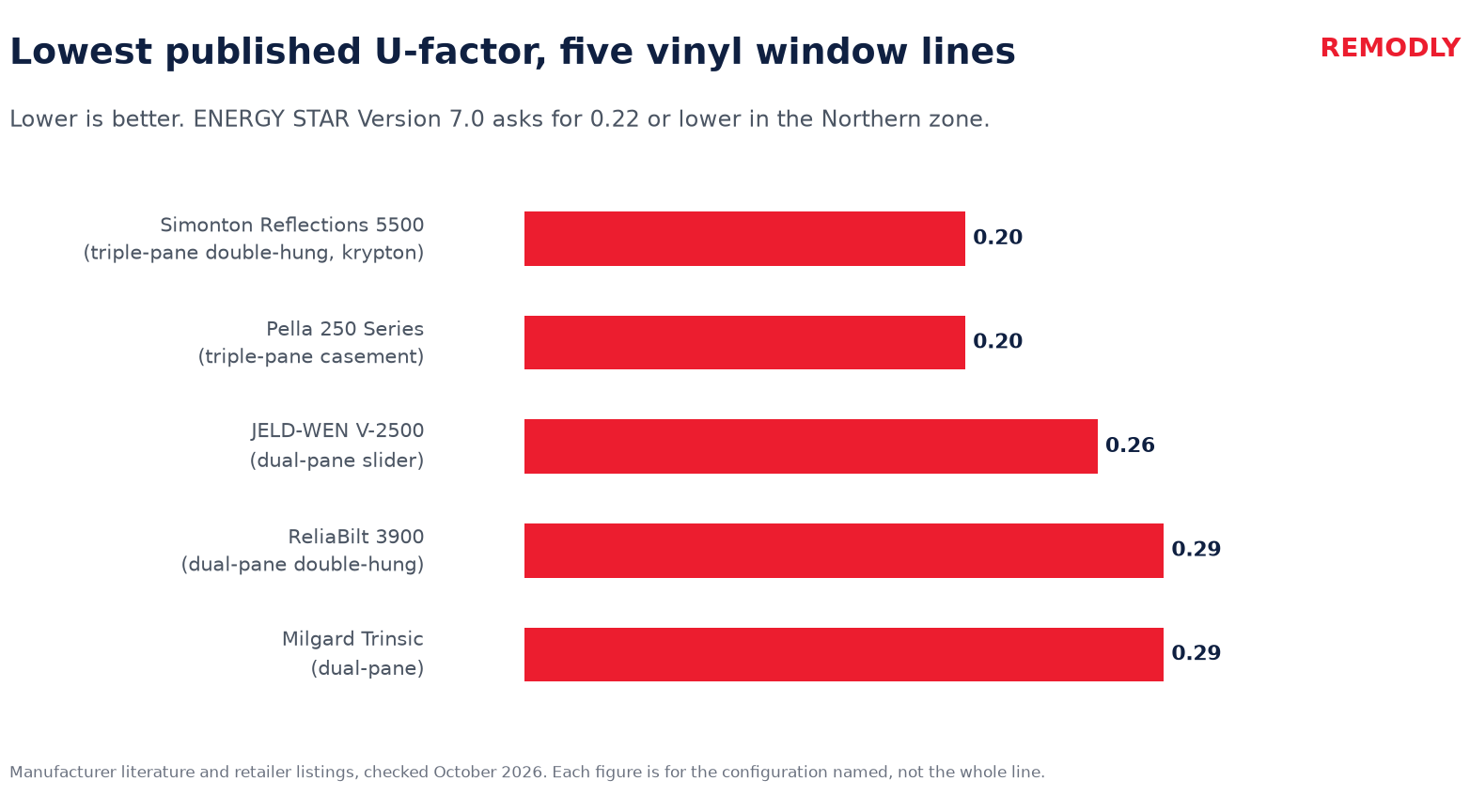
Three things sit outside that chart and matter at least as much.
Solar heat gain cuts both ways. A low U-factor with a high solar heat gain coefficient is a good northern window and a bad southern one. ENERGY STAR Version 7.0 now sets a minimum solar heat gain of 0.17 in the Northern zone and a maximum of 0.23 in the South-Central and Southern zones, precisely because the right answer flips at the latitude (ENERGY STAR 7.0 summary). Buy for your climate zone, not for the lowest number on the page.
Air leakage is the spec nobody quotes. U-factor describes heat moving through a closed window. Air leakage describes air moving around it. Casements pull shut against a compression seal; double-hungs and sliders seal against brushes and fins that wear. If a line publishes an air leakage rating, read it. Most do not.
Installation can undo any of it. A 0.20 window set in an unsealed opening performs like a 0.30 window, and no warranty covers that. Our window installation guide walks through what a competent crew actually does on the day, and how to choose replacement windows covers vetting the installer before the frame material.
What vinyl windows cost in 2026
Fixr puts the national average for an installed vinyl window at $575 in its January 2026 update, with most falling between $350 and $800 (Fixr). Inch Calculator's 2026 guide lands in the same place at $400 to $800 (Inch Calculator).
Pella's own 2026 replacement cost page is far higher, at $800 to $1,600 per installed window (Pella). Both can be true at once. The aggregators average shelf-stock units fitted by independent installers; the manufacturer is quoting its own dealer-installed projects with carpentry and disposal priced in. If your quotes come back above $800 a window, you are shopping the second market, and it is worth knowing that before you negotiate. Our window replacement cost guide breaks the line items down, and the Chicago window replacement guide shows how far a single metro can move the same scope.
One line item is now missing from every one of those budgets. The federal Section 25C credit, worth 30 percent of cost up to $600 a year on qualifying windows, was repealed for property placed in service after December 31, 2025 (Pease Bell summary). Eligibility turned on installation date rather than purchase date, so windows bought in late 2025 and fitted in 2026 do not qualify. Treat any 2026 sales pitch that leans on the tax credit as a reason to check the rest of the pitch.
Where the money is actually worth spending
Buy the glass package, not the brand. The gap between a line's baseline glass and its best glass is routinely wider than the gap between two different manufacturers, as Pella's own 0.26 to 0.30 spread on the same frame shows. Specify Low-E with argon as a floor, and price the triple-pane or krypton upgrade as a separate line so you can see what it costs.
Spend on the openings you feel. A north-facing room that never warms up and a west-facing room that bakes every afternoon are worth the upgraded package. A hall window above a stairwell is not. Mixing packages across one house is routine.
And be honest about the payback. Replacing functional single-pane windows will not repay itself in energy savings in any reasonable timeframe. Replacing windows that are rotted, painted shut or fogged between the panes is a different decision, and comfort is a legitimate reason to buy. Just do not let it be sold to you as an investment.
Get the window quote checklist
We built a one-page checklist for comparing window quotes: the specs to demand in writing, the lines that belong on any itemized bid, and the questions that separate an installer who air-seals from one who does not. We publish a new breakdown every week. Subscribe and we will send the checklist now and the next breakdown first.
Sources: manufacturer literature and retailer listings linked inline above, plus the ENERGY STAR Version 7.0 criteria summary and 2026 cost data from Fixr, Inch Calculator and Pella. All figures checked October 2026. Ratings vary by size and glass package, so confirm against the NFRC label on the unit you are quoted.
Frequently Asked Questions
What is a good U-factor for a vinyl window?
It depends on your climate zone. ENERGY STAR Version 7.0 asks for 0.22 or lower in the Northern zone, 0.25 in North-Central, 0.28 in South-Central and 0.32 in the Southern zone (ENERGY STAR 7.0 summary). Most dual-pane vinyl windows land between 0.26 and 0.30, so hitting the northern threshold usually means triple glazing or an upgraded gas fill.
Which vinyl window has the lowest U-factor?
Of the five lines compared here, Simonton's Reflections 5500 publishes the lowest figure at 0.20, on a triple-pane double-hung with ProSolar Low-E glass and krypton fill (Simonton sell sheet). Pella's 250 Series publishes the same 0.20 on a triple-pane casement.
Are vinyl windows worse than fiberglass or wood?
Not on energy performance, which is driven mainly by the glass package and the gas fill rather than the frame material. Vinyl's real trade-offs are structural and cosmetic: frames are thicker for the same glass area, dark colors are limited on many lines, and vinyl cannot be refinished. In exchange it needs no maintenance and costs less than every alternative.
How much do vinyl windows cost installed in 2026?
Expect $350 to $800 per window, averaging around $575 nationally (Fixr). Manufacturer dealer channels quote higher, with Pella citing $800 to $1,600 per installed window (Pella). Carpentry in the opening, masonry, and upper floors push any of these up.
Is there still a tax credit for new windows?
Not federally. The Section 25C credit, worth 30 percent of cost up to $600 a year for qualifying windows, was repealed for property placed in service after December 31, 2025 (Pease Bell summary). Eligibility turned on the installation date, not the purchase date. State and utility rebates may still apply, so check with your own utility before counting on anything.
Does a lifetime warranty on a vinyl window mean much?
Read what it covers rather than what it is called. Across these five lines, coverage of accidental glass breakage is standard on some and an optional upgrade on others, and transferability varies. The seal failure term matters most in practice, because a fogged insulating glass unit is the most common reason a vinyl window gets replaced before the frame fails.