
Kitchen Remodeling
Plan your dream kitchen with confidence. From custom cabinets and quartz countertops to open-concept layouts and luxury appliances, find vetted kitchen remodeling contractors near you. Free quotes in 60 seconds.
Find My ProA kitchen remodel is one of the most impactful home improvement investments you can make. It transforms your daily routine, dramatically increases your home's resale value, and creates a functional space that truly works for your family. Industry data shows kitchen renovations recoup 60-80% of their cost at resale, making them one of the highest-ROI home improvement projects in 2026.
Whether you're considering minor kitchen updates like new cabinet hardware and a fresh backsplash, a mid-range kitchen remodel with new cabinetry and quartz countertops, or a complete gut renovation with custom cabinets and luxury appliances, the right kitchen remodeling contractor makes all the difference. The kitchen is where families gather, where memories are made, and where the value of your home is anchored.

Services
From cosmetic refreshes to full gut renovations, choose the right kitchen remodeling scope for your budget and goals.
Refresh your kitchen with new hardware, paint, backsplash, and lighting. Perfect for sellers preparing a home for market or homeowners wanting a quick lift without major construction. Typical range $10,000–$15,000.
The most popular scope for resale-driven projects. New cabinets, quartz countertops, updated flooring, modern appliances, and refreshed lighting. Delivers maximum return on investment for the typical home. Typical range $25,000–$50,000.
Complete gut and rebuild with custom cabinetry, premium stone countertops, professional-grade appliances, and an updated layout. Often involves moving plumbing and electrical. Typical range $50,000–$100,000+.
Expand your kitchen footprint or remove walls to create an open-concept design. Includes structural engineering, load-bearing wall analysis, and electrical reroutes. Typical range $75,000–$150,000+.
Cost Guide
Kitchen remodeling costs vary widely based on project scope, materials, and your local labor market. Here's what to budget by tier so you can plan with confidence and avoid sticker shock when you start getting quotes from kitchen contractors near you.
Paint, new hardware, a fresh backsplash, updated lighting fixtures, and minor plumbing fixture swaps. Ideal for sellers staging a home or homeowners on a tight budget. Labor is the largest cost driver at this tier, typically 50–60% of total spend.
New stock or semi-custom cabinetry, quartz or granite countertops, updated appliances, new flooring, and refreshed lighting. The most popular scope for primary residences. Delivers the strongest ROI at resale in most markets and typically takes 6–8 weeks.
Complete gut with custom cabinetry, premium stone countertops (quartzite, marble), professional-grade appliances (Sub-Zero, Wolf, Viking), and layout changes that move plumbing or electrical. May include hardwood floor refinishing and structural updates.
Open-concept conversions, kitchen additions, butler's pantries, and chef-grade installations. Includes load-bearing wall removal, second-story support, structural engineering, and high-end finishes throughout. Common in upscale markets and homes valued $1M+.
Prices shown are estimates for planning purposes only and do not represent a final price. Your actual cost depends on project scope, materials, and your local market.
Timeline
A typical kitchen remodel takes 6–12 weeks from contractor selection to final walkthrough. Here's how the phases break down so you can plan around your daily routine and family events.
Work with your kitchen designer or contractor to finalize the layout, choose cabinetry, select countertops, and order materials. Cabinet lead times alone can run 4–8 weeks for semi-custom and 10–16 weeks for fully custom, so order early.
Old cabinets, appliances, flooring, and fixtures are removed. The space is prepped for rough-in work. Expect dust, noise, and limited kitchen access during this phase, set up a temporary kitchen elsewhere in the home.
Plumbing relocations, electrical updates (often including new circuits for high-amp appliances), and any HVAC modifications. Inspections happen at the end of this phase. Drywall and primer come after sign-off.
Cabinets are installed first. Countertops require templating after cabinets are in place, then fabrication (1–2 weeks) before final install. Backsplash tile goes in after countertops. This is the phase where your kitchen starts to look like a kitchen again.
Appliances hooked up, lighting installed, hardware attached, paint touched up, and a punch list of minor items is completed. Final inspection, then you have your dream kitchen.
Design Ideas
Browse the kitchen design styles most requested by American homeowners in 2026. The right style sets the tone for cabinetry, countertops, hardware, and lighting choices.
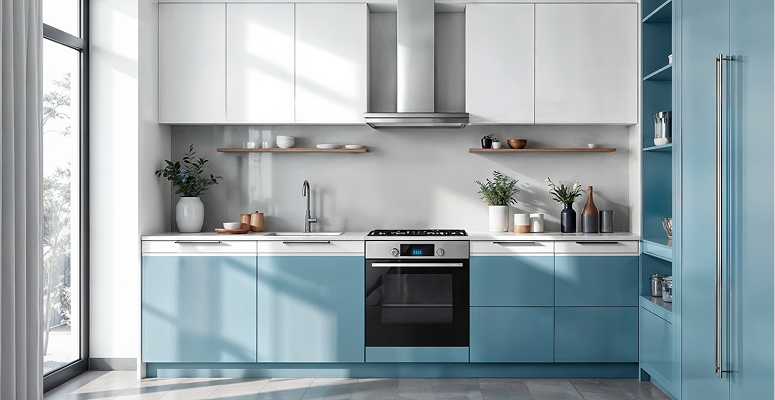
Clean lines, flat-panel cabinets, waterfall quartz islands, integrated appliances, and minimalist hardware. Often paired with handle-less cabinet pulls and matte finishes. The choice for new construction and recently remodeled homes.
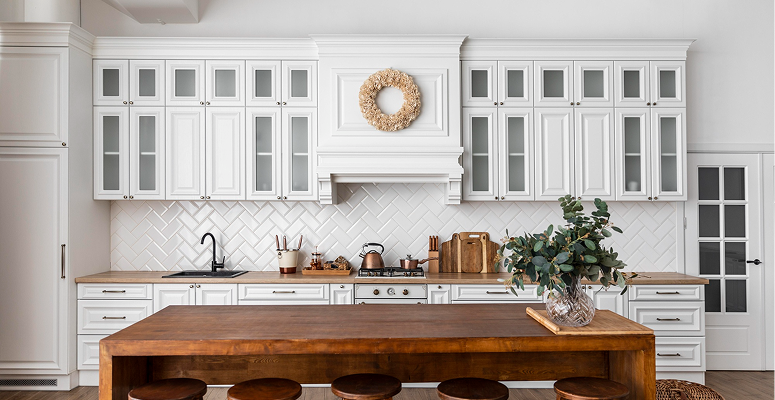
White shaker cabinets, butcher block or marble countertops, apron-front farmhouse sinks, open shelving, and matte black hardware. Warm, inviting, and the most popular style on Pinterest for the past several years running.
A blend of traditional and contemporary, neutral palette, shaker cabinets, quartz counters, and balanced hardware. The safest resale-friendly choice that appeals to the widest range of buyers.
Light blues and whites, beadboard accents, brass or polished nickel fixtures, and bright airy lighting. Popular in coastal markets but works anywhere homeowners want a relaxed, vacation-inspired vibe.
Exposed brick, concrete countertops, dark cabinetry, open metal shelving, and Edison-style pendants. Best in lofts and urban remodels where the architecture supports the bold material palette.
Raised-panel cabinets, decorative molding, granite countertops, and classic hardware. Timeless and well-suited to colonial, Tudor, and traditional home architectures.
Materials Guide
Material choices drive both the look and the longevity of your kitchen remodel. Here's how to pick countertops, cabinetry, flooring, and backsplash that will look great in ten years.
Quartz is the most popular choice in 2026, engineered, non-porous, no sealing required, and available in nearly any pattern. Granite remains popular for its natural beauty and durability. Marble brings premium luxury but stains and etches. Butcher block works on islands and prep areas. Budget $50–$200 per square foot installed.
Stock cabinets ($5K–$10K per kitchen) ship from stock sizes and ship in days. Semi-custom ($10K–$20K) offers more sizes, finishes, and door styles. Custom cabinets ($20K–$50K+) are built to your kitchen's exact dimensions with any finish. Solid wood plywood boxes outlast particleboard by decades.
Hardwood remains the classic choice and refinishes beautifully. Luxury vinyl plank (LVP) is waterproof, durable, and great over concrete. Porcelain tile is the most durable option but harder underfoot. Heated floors add comfort under any of these for $8–$15 per square foot installed.
Subway tile remains the most popular at $5–$15 per square foot. Natural stone mosaics and slab backsplashes are trending for premium kitchens. Quartz slab backsplash creates a seamless look continuous with countertops. Hand-painted ceramic brings character to farmhouse and Mediterranean designs.
Kitchen remodel costs in 2026 typically range from $10,000 for cosmetic updates to $100,000+ for full renovations. Most homeowners spend between $25,000 and $50,000 on a mid-range kitchen remodel including new cabinets, quartz countertops, updated appliances, and flooring. Costs vary significantly by region, with coastal cities like San Francisco, New York, and Los Angeles running 30–50% higher than the national average due to labor costs and material premiums.
A typical kitchen remodel takes 6–12 weeks of active work from demolition to final walkthrough, but you should plan for an additional 4–12 weeks of upfront design and material ordering, especially for custom cabinetry which has the longest lead time. Minor updates can finish in 2–3 weeks while full gut renovations with layout changes may stretch to 14–16 weeks. The biggest delays usually come from cabinet lead times, custom countertop fabrication, and inspection scheduling.
The best kitchen layout depends on your space and how you cook. The classic work triangle, sink, stove, and refrigerator positioned within a few steps of each other, still applies, but open-concept kitchens now favor zones over triangles: prep zone, cooking zone, cleanup zone, and storage zone. L-shape and U-shape layouts maximize counter space in medium kitchens, while galley and one-wall designs work best for narrow spaces. A kitchen island remains the most-requested feature for added storage, seating, and prep space.
Yes, but expect significant disruption. Plan a temporary kitchen elsewhere in the home, often in a basement, garage, or dining room, with a microwave, mini fridge, toaster oven, coffee maker, and disposable plates and utensils. The first 1–2 weeks (demolition and rough-in) are the dustiest and noisiest. Many homeowners find the inconvenience manageable for a mid-range remodel but choose to stay elsewhere during a full gut renovation, especially if they have small children or work from home.
According to Remodeling Magazine's Cost vs. Value Report, mid-range minor kitchen remodels recoup an average of 70–85% at resale, the highest ROI of any major renovation. The upgrades that drive the most value are: quality cabinet boxes (plywood not particleboard), durable countertops (quartz or granite), modern stainless or paneled appliances, updated lighting (recessed plus pendants), and a fresh neutral paint palette. Avoid over-personalizing finishes if you plan to sell within five years.
Most kitchen remodels require permits, especially if you're moving plumbing, adding electrical circuits, removing walls, or changing the layout. Cosmetic-only updates (paint, hardware, replacing fixtures in the same location) typically don't require permits. Your kitchen remodeling contractor should pull permits as part of the project, and inspections will be scheduled at rough-in and final stages. Working without required permits can void homeowner's insurance and create issues at resale.
Resources